Research

Reliable AI from the inside out

diagnose the mechanism → repair the failure → deploy with trust

I study how large multimodal models and agents compute internally, and why they fail. I use that understanding to build models that reason reliably, in training and at inference, and agents that act reliably in open, embodied environments.

Inputs
  • Vision
  • Language
  • 3D space
  • Action
  • Skills
01DiagnoseMechanistic analysis of where and why models fail
02RepairPrincipled fixes in both training and inference
03DeployReliable self-evolving and embodied agents
Outcomes
  • 3D spatial perception
  • VLA & world-action models
  • Self-evolving agents

01 · Diagnose

Mechanistic Diagnosis of Multimodal Models

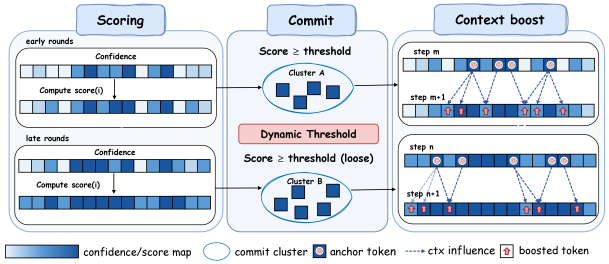
Reliability starts with knowing where things break. I analyze information flow, attention, and saliency inside vision–language models and diffusion MLLMs to explain failures such as hallucination, attention sinks, and the repetition curse under cache acceleration.

  • information flow
  • attention sinks
  • hallucination
  • dMLLMs
Context tokens as anchors in diffusion MLLMs
Context tokens act as anchors in dMLLMs
Hallucination begins where saliency drops

02 · Repair

Reliable Reasoning, in Training and Inference

Each diagnosis becomes a principled fix. When models learn, I redesign positional encodings and attention structure so they keep visual and spatial grounding. When they generate, I design decoding and token-level strategies that keep outputs coherent and faithful.

  • training-time priors
  • inference-time intervention
  • positional encoding
  • decoding
Manhattan causal attention
Manhattan causal attention against positional decay
Anchor-driven cluster decoding

03 · Deploy

Reliable Agents in Open Environments

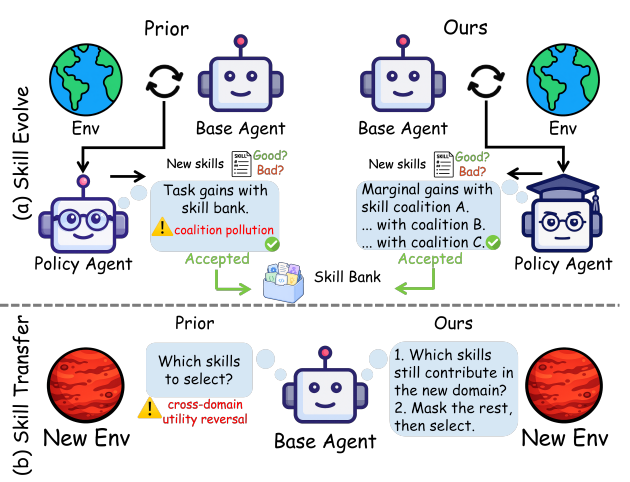
Agents that improve themselves also need to be checked. I study when the skills a self-evolving agent accumulates actually help, exposing failures such as coalition pollution and cross-domain utility reversal. I also study how embodied models can interleave reasoning with action.

  • self-evolution
  • skill reliability
  • embodied reasoning

Selected work

Coalition-aware skill selection
Auditing skill coalitions in self-evolving agents
Interleaved embodied chain-of-thought
Interleaved embodied reasoning

↳Embodied Testbed

In embodied settings, reliability is more than a benchmark number. A hallucinated object or a misplaced coordinate becomes a failed action, which makes these settings the proving ground for everything above.

SoPE overview

Spatial perception

3D-aware multimodal models

Positional encodings that respect 3D geometry and causal order, so that models know where things are.

Embodied chain-of-thought overview

Embodied reasoning

Thinking while acting

Interleaving chain-of-thought with perception and action for more reliable robot decision making.

  • Embodied CoT via interleaved reasoningIROS'26 Oral
Coalition-aware skill reliability overview

Open-world self-evolution

Self-evolving embodied agents

Agents that keep improving in open environments while their skills stay verifiably useful. This line extends to VLA and world-action models.

Ongoing · VLA & WAM